Payout Patterns and Risk Elements in Multi-Bet Accumulators for England's Top Two Football Divisions
Written by Finley Becker · Sep 25, 2026
Payout Patterns and Risk Elements in Multi-Bet Accumulators for England's Top Two Football Divisions
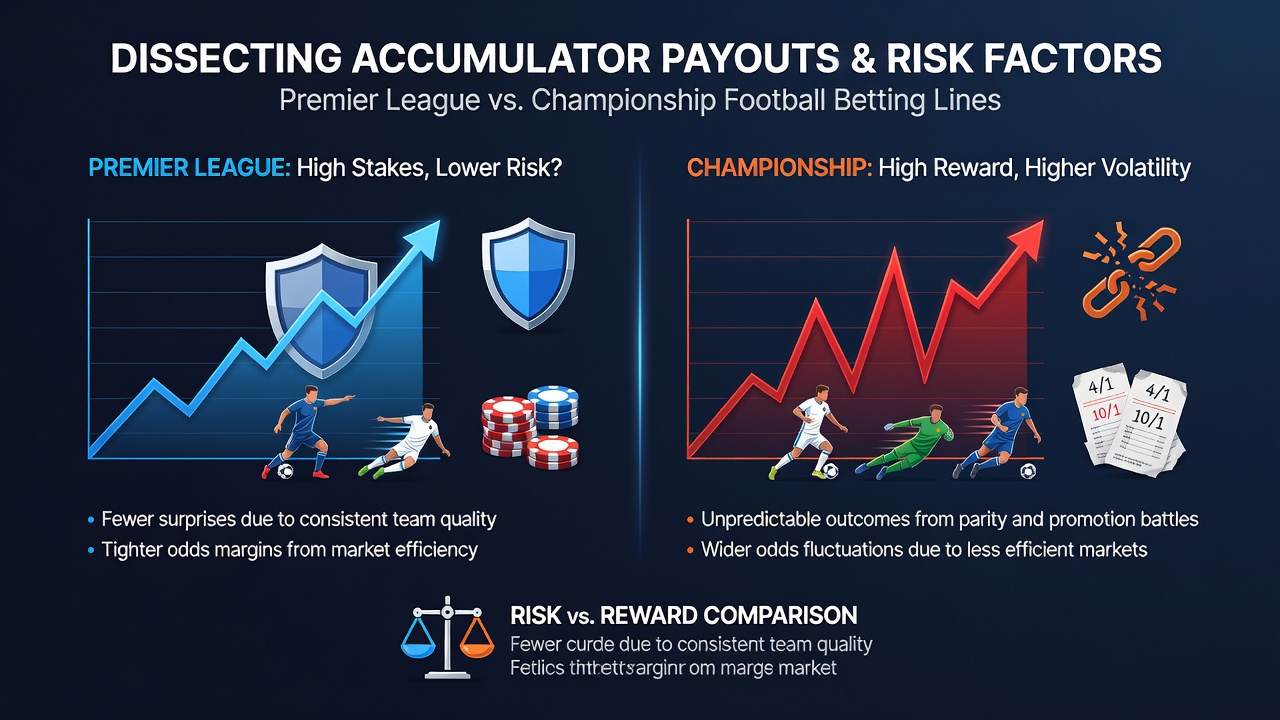
Accumulator bets combine multiple selections into one wager where all legs must succeed for a payout to occur, and this structure creates exponential growth in potential returns alongside complete loss if any single outcome fails. Data from betting operators show that Premier League lines typically feature shorter odds on match results because the division maintains greater competitive balance among established clubs, whereas Championship fixtures produce longer odds due to higher unpredictability in team performance and results. Observers note that these differences directly influence how accumulators build their final multipliers, with Championship selections often pushing combined odds higher even when fewer legs are included.
Core Mechanics of Accumulator Construction
Bookmakers calculate accumulator payouts by multiplying the decimal odds of each selected leg, then subtracting the stake to determine profit, and this method means that a four-leg bet at average odds of 2.0 per selection yields a 16.0 multiplier before any margin adjustments. Research from sports analytics groups indicates that margins embedded in individual odds compound across accumulator legs, which elevates the effective house edge compared with single bets. Those who track historical lines find that Premier League accumulators frequently rely on favorites because those selections carry lower individual risk yet still deliver modest combined returns when four or five legs are stacked.
Premier League Accumulator Characteristics
Premier League matches generate more consistent data sets for modeling because the league features stable squad investments and fewer mid-season managerial changes, and this stability translates into tighter betting lines that favor shorter-priced outcomes. Studies of five seasons ending in 2025 reveal that home favorites in the Premier League win at rates near 45 percent on average, which supports accumulator builders who include multiple home wins or over-2.5 goals selections. Yet the division also produces occasional upsets that wipe out entire accumulators, and data shows these disruptions occur most often in matches involving newly promoted sides facing established mid-table teams.
Championship Accumulator Characteristics
The Championship exhibits greater variance in results because promotion and relegation pressures create inconsistent motivation levels across the 24-team roster, and this variance produces longer average odds on both match winners and goal totals. Figures from league performance databases covering 2020 through 2025 indicate that away wins occur at rates above 30 percent in the Championship, compared with roughly 25 percent in the Premier League, which allows accumulator constructors to incorporate underdog selections that boost overall multipliers substantially. Those analyzing payout histories observe that successful Championship accumulators often require fewer legs to reach equivalent returns because individual odds start higher.
Comparative Risk Assessment
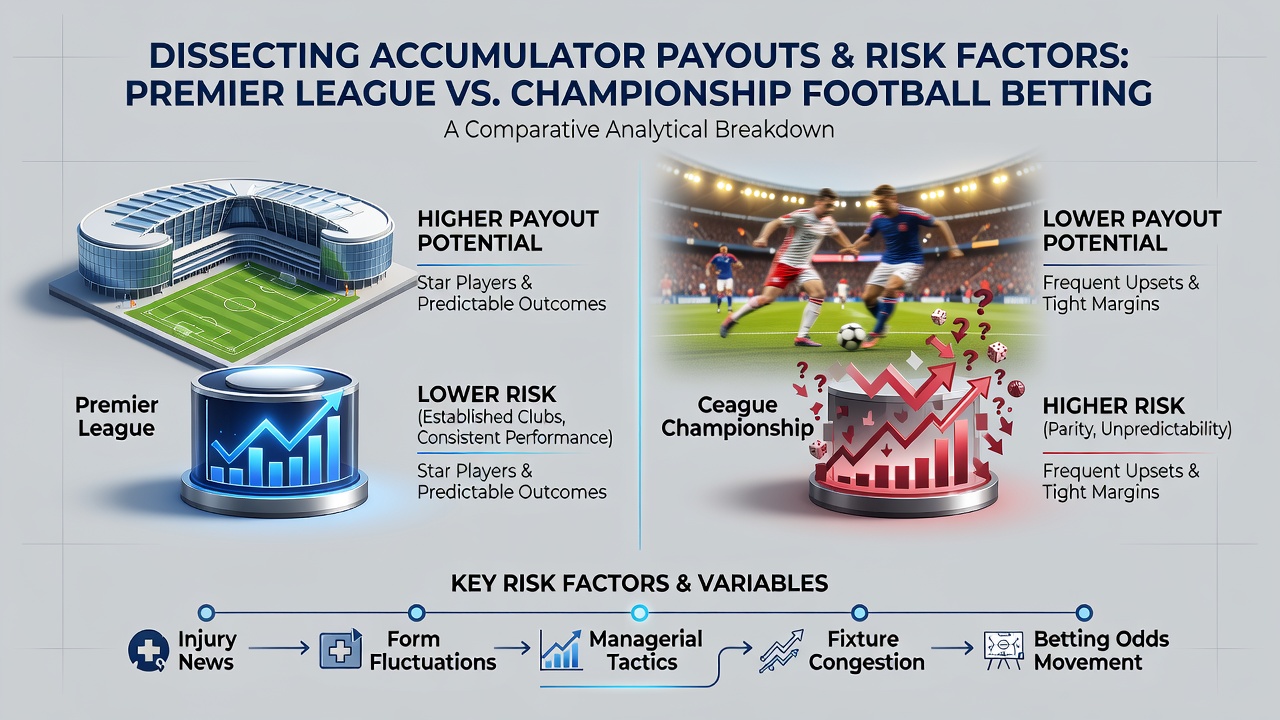
Risk in accumulators stems primarily from the requirement that every leg succeeds, and this all-or-nothing structure amplifies small differences in individual leg probabilities into large differences in overall success rates. Analysis of operator data sets demonstrates that a four-leg Premier League accumulator with average per-leg win probability of 55 percent carries an overall success chance near 9 percent, while the same structure using Championship legs at 48 percent per-leg probability drops overall success below 5 percent. Experts tracking these patterns note that the longer odds in the Championship compensate for the reduced probability only when bettors accept the steeper drop in hit rate.
Seasonal Influences and Line Movement
As of September 2026, early-season betting lines in both divisions reflect limited sample sizes that increase variance around expected outcomes, and this effect appears more pronounced in the Championship where squad turnover remains elevated. Line movement data collected by analytics platforms shows that accumulator odds on Premier League matches tend to shorten faster once public money concentrates on favorites, whereas Championship lines retain value longer because betting volume stays lighter. Researchers examining these movements find that late adjustments often compress margins on high-profile Premier League accumulators more than on their Championship counterparts.
Practical Examples of Payout Trajectories
One documented case from the 2024-2025 season involved a five-leg Premier League accumulator built around home wins and over-2.5 goals selections that returned 12.4 times the stake after all legs landed, while a parallel Championship accumulator using four longer-priced away selections returned 18.7 times despite fewer legs. These examples illustrate how the Championship's elevated odds can offset its lower per-leg reliability when bettors construct shorter accumulators. Data compiled across multiple operators confirms that the average payout multiplier for successful Championship accumulators exceeds that of Premier League equivalents when leg counts are equalized.
Conclusion
Accumulator payouts and associated risks diverge clearly between the Premier League and Championship because of measurable differences in result consistency, average odds, and seasonal volatility. Operators adjust lines according to these patterns, while bettors who examine historical probabilities can identify where multipliers align with acceptable risk thresholds. Continued tracking of performance data through 2026 will further clarify how these two divisions shape accumulator strategies across English football betting markets.